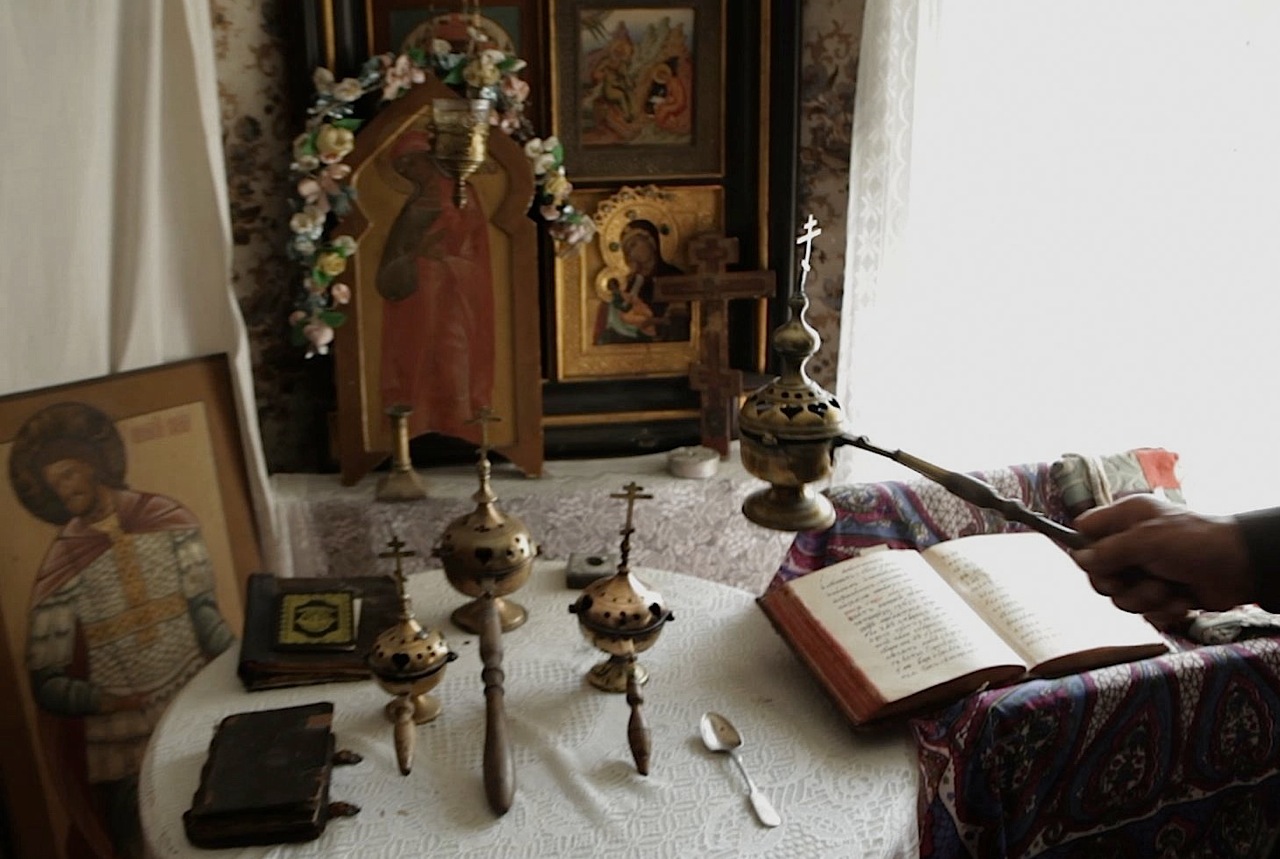
Our last day started with the visit to the actual church service with Osip, which he promised us a few days back. Unlike in Kasepää, where Father Andrej didn't want us to film in the church, Osip in Raja doesn't seem to have any problem with this - well, it's natural and also beautiful that everyone has an own approach to these sort of things, and we of course respect their views.
The celebration in Raja was amazing, colorful, interesting, and breathtaking. The celebration was about the opening of the apple eating season, so a basket of apples was blessed. The visitors of the service were friendly and apparently didn't feel disturbed by our presence; actually at the end of the service, an elderly lady came to us and said that she had expected us to be disturbing, and that she was very happy that we were behaving so considerate. Very nice indeed, since of course we're there to observe, and not to go on people's nerves or to make them feel uncomfortable in something that for them certainly is a very intimate moment.
We spent the last few hours filming a few more scenes outdoors, after the service, eating the remaining fish and onions, and getting ready to leave the region until we will return in October. We said goodbye to some of the people we met (those we could contact or find in this day). As melancholic to leave the region as we somewhat are, we are also happy at the same time that we are visibly welcome, we are not perceived as intruders, but are treated very friendly and open, and we even believe to see that many of the people we met repeatedly are indeed happy to see us, interested to talk with us, to share their views, to have a conversation. So after 13 days, we think we're on a good way, we have collected some very intense and very interesting footage and statements and views, and are optimistic about this project and what will come out of it.
So this blog will take a break as well, while all of us are traveling back home and will get busy with other projects and with planning the next steps in this one. We'll be back in October. Back here on this blog, and back at the lake.
Live coverage from the shore of Lake Peipus, as we go around collecting and documenting the life and stories of the Russian Old-Believers who live here.
Thursday, 19 August 2010
Wednesday, 18 August 2010
Day 12: Fishing business, planning trips, review
Woke up early to meet the Filipov family, who agreed to give us a tour through their fish factory and their house. The Filipovs most probably are the richest family in these villages - the factory is impressive, and the house is beautiful and decorated pompously, including of course some impressive icons in the dining room.
Mrs Filipova explains us how they started and developed their business, from nothing to what it is today, all self-made and with a lot of entrepreneurial spirit. It's a family business, in a way, with Mrs Filipova's three sons all working for the factory. So we were told the story of the family business and shown the beautiful house, learned also that Mrs Filipova is the sister of Matjushka Varvara whom we met earlier.
We wanted to go fishing, but they explain us that it's not possible right now: Fishing in Lake Peipus is only allowed at certain times, and currently we're in the "dry season". There's only some smoked fish left in the storage, no new catches are coming in. From about mid September until November, fishing will be allowed again, so we agree that they will take us out for a fishing trip when we come back in autumn.
After meeting the Filipov family, we face more rain and stormy weather, so we go back and cook some pasta using the tomatoes that Osip from Raja sold us the other day. We go to the cute little Kivi Korts, the cafe/bar/restaurant where we stop once in a while, to have a cup of coffee and to review all the material we filmed so far, since tomorrow during the day we're already leaving, and it's time to understand what we've achieved and what's still missing, what topics we think we covered and where we want to dig deeper, so we can prepare for our next trip here in autumn. From the first look and review, we're quite happy with the results of these first 12 days. Half a day more to go tomorrow, then we're off until autumn.
Mrs Filipova explains us how they started and developed their business, from nothing to what it is today, all self-made and with a lot of entrepreneurial spirit. It's a family business, in a way, with Mrs Filipova's three sons all working for the factory. So we were told the story of the family business and shown the beautiful house, learned also that Mrs Filipova is the sister of Matjushka Varvara whom we met earlier.
We wanted to go fishing, but they explain us that it's not possible right now: Fishing in Lake Peipus is only allowed at certain times, and currently we're in the "dry season". There's only some smoked fish left in the storage, no new catches are coming in. From about mid September until November, fishing will be allowed again, so we agree that they will take us out for a fishing trip when we come back in autumn.
After meeting the Filipov family, we face more rain and stormy weather, so we go back and cook some pasta using the tomatoes that Osip from Raja sold us the other day. We go to the cute little Kivi Korts, the cafe/bar/restaurant where we stop once in a while, to have a cup of coffee and to review all the material we filmed so far, since tomorrow during the day we're already leaving, and it's time to understand what we've achieved and what's still missing, what topics we think we covered and where we want to dig deeper, so we can prepare for our next trip here in autumn. From the first look and review, we're quite happy with the results of these first 12 days. Half a day more to go tomorrow, then we're off until autumn.
Tuesday, 17 August 2010
Day 11: Storm, female priests, language
ast night there was a storm, the little houses were shaking a little and rain knocked on the big windows. The morning after the storm then featured the greatest sunrise ever seen, with waves that made our beloved lake look like the Atlantic Ocean. As said earlier, this lake really feels like the sea.
We then went to interview Matjushka Varvara, a female priest (actually a sort of minister, just like Andrej, since there are no real priests in the Old Believers' religion). Varvara is 80 years old, has five children and uncounted grandchildren. She was made the priest or minister of this church by the previous priest, also a woman, when this previous priest died: On her deathbed, she asked Varvara to take over this position from her, and because it was necessary and there was nobody else who could do it, Varvara accepted.
Later we interviewed Matjushka Zoya, who used to be a doctor and is now also a priest or minister in one of the churches. We had a long and deep conversation with her, too, and got a lot of apples from her garden as a present. Strong ladies, open and devoted to what they do.
We walked around, and met Timofey who was busy working on his potato field. We talked with him for a while. Turns out one of the crosses in the church is indirectly "his", as it was a donation from Timofey's father to the church, in order for his son to be protected: Timofey was a parachutist.
In the evening, Bettina went around the area alone again. Without a whole team that runs around with sound equipment and tripods and so on, it's often just easier to get in touch with people who'd otherwise be naturally a bit shy in front of a whole group. We schedule interviews with people whom we find particularly interesting, of course, but if we did only that, we'd miss out on many small moments, and we'd miss many people who aren't well-known around the villages. So for photographic and for film material of more people, Bettina sometimes goes around alone, less intrusive, allowing a more personal and quick touch with people met. Since Bettina speaks neither Russian nor Estonian, there are of course also quite cute situations coming out of this: The speechlessness allows for a sublime contact, amusing situations, mutual laughter, it's an entirely different situation and feeling than if you can exchange your thoughts. Both sides become a bit like friendly dogs who are circling around each other for a while, trying to express basic emotions or attitudes, but not able to say anything to each other. Some nice photos come out of this. The kids are a bunch of locals and holiday guests who play together bilingually, running around and shouting in both Estonian and Russian languages (so much Bettina understands even without understanding the words, of course).
And naturally, Liza is around, too, with her favourite dog Tobi. She's always somewhere, and has obviously adopted us as some of her new friends: She still tries to teach us how to throw berries up in the air and catch them with his mouth, and we fail miserably, which she visibly enjoys. And she keeps sharing her favourite pets with us: Here's Liza on the street with Tobi, when Bettina met them in the evening.
We then went to interview Matjushka Varvara, a female priest (actually a sort of minister, just like Andrej, since there are no real priests in the Old Believers' religion). Varvara is 80 years old, has five children and uncounted grandchildren. She was made the priest or minister of this church by the previous priest, also a woman, when this previous priest died: On her deathbed, she asked Varvara to take over this position from her, and because it was necessary and there was nobody else who could do it, Varvara accepted.
Later we interviewed Matjushka Zoya, who used to be a doctor and is now also a priest or minister in one of the churches. We had a long and deep conversation with her, too, and got a lot of apples from her garden as a present. Strong ladies, open and devoted to what they do.
We walked around, and met Timofey who was busy working on his potato field. We talked with him for a while. Turns out one of the crosses in the church is indirectly "his", as it was a donation from Timofey's father to the church, in order for his son to be protected: Timofey was a parachutist.
In the evening, Bettina went around the area alone again. Without a whole team that runs around with sound equipment and tripods and so on, it's often just easier to get in touch with people who'd otherwise be naturally a bit shy in front of a whole group. We schedule interviews with people whom we find particularly interesting, of course, but if we did only that, we'd miss out on many small moments, and we'd miss many people who aren't well-known around the villages. So for photographic and for film material of more people, Bettina sometimes goes around alone, less intrusive, allowing a more personal and quick touch with people met. Since Bettina speaks neither Russian nor Estonian, there are of course also quite cute situations coming out of this: The speechlessness allows for a sublime contact, amusing situations, mutual laughter, it's an entirely different situation and feeling than if you can exchange your thoughts. Both sides become a bit like friendly dogs who are circling around each other for a while, trying to express basic emotions or attitudes, but not able to say anything to each other. Some nice photos come out of this. The kids are a bunch of locals and holiday guests who play together bilingually, running around and shouting in both Estonian and Russian languages (so much Bettina understands even without understanding the words, of course).
And naturally, Liza is around, too, with her favourite dog Tobi. She's always somewhere, and has obviously adopted us as some of her new friends: She still tries to teach us how to throw berries up in the air and catch them with his mouth, and we fail miserably, which she visibly enjoys. And she keeps sharing her favourite pets with us: Here's Liza on the street with Tobi, when Bettina met them in the evening.
Monday, 16 August 2010
Day 10: Raja church, female priest, Bettina exploration
After breakfast, we went to a village called Raja in order to meet Osip Jotkin, who is involved with the Old Believer church in this village. The church is famous for the very special icons it has, painted by a master icon painter called Frolov. We want to meet Osip so he can tell us about the particularities of the Raja church, the icons, the history of their community.
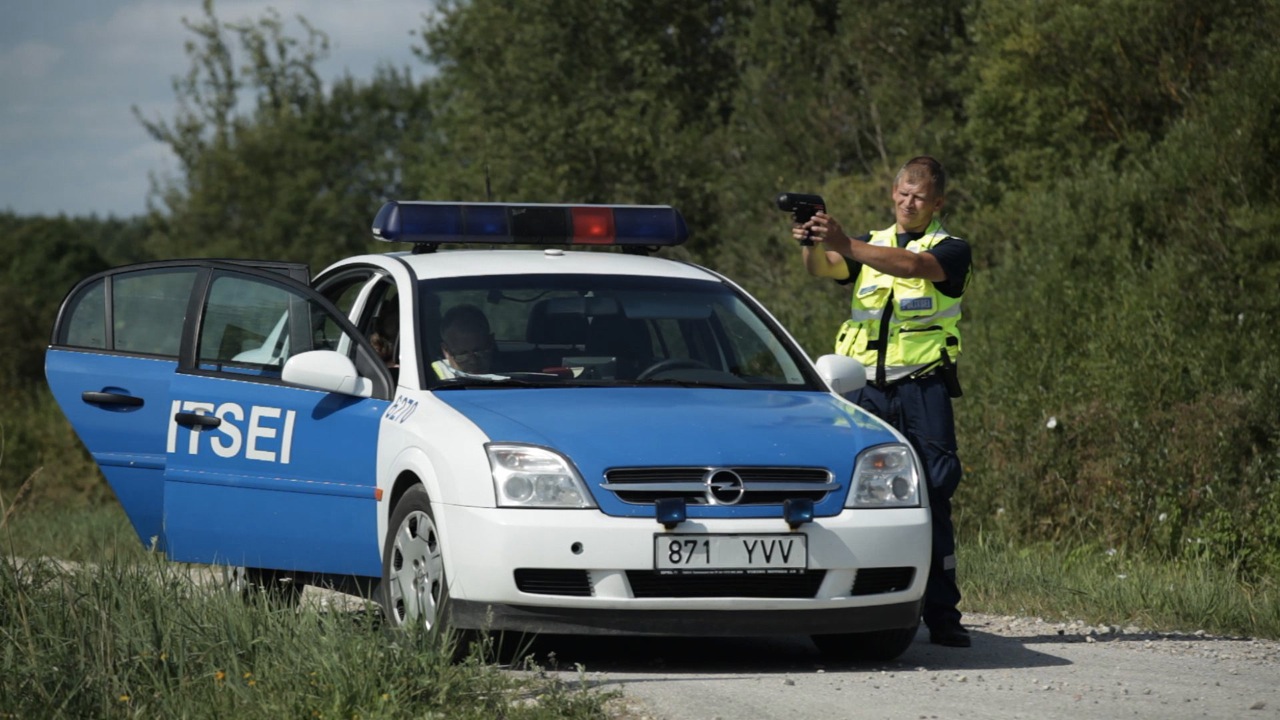
We meet Osip at the side of the road, as agreed, in front of his house, where he sells onions and tomatoes. Osip is a cheerful and charismatic person, a picture of the "nice grandfather" with a big white beard and a face that tells of a colorful and active life. We buy some tomatoes from him and start talking about his family, his daughters, and life in general, as well as about the police who had just parked across the street to do speed checks of passing cars, and whom Osip of course knows, too.
He tells us about Frolov, the church which Frolov paid for with his own money, about the school of icon painting and how young people were taught to read and write Church Slavonic, and about the history of the Old Believer community in Raja. He then takes us to the church, and we're allowed to have a look at the main hall which is full of amazingly crafted icons; he explains us some of the icons, their history, and some of the rituals of the Old Believers which we had witnesses before, but never were explained. We also see the room where Frolov lived with a collection of memorabilia, and the former study rooms. Indeed the icons in Raja church are impressive works of art, and Osip is one more great and fascinating person to speak with, who possesses a huge knowledge of his region and religion, and is happily sharing it.
Later on, Bettina and Katerina planned to talk with one priest (respectively a ceremony leader) of the Kolkja Old Believer church, who happens to be a woman - interview will take place tomorrow And Mairi is back from Tallinn - while we pick her up from Tartu railway station, Bettina explores the lakeside villages by herself with the camera.
Sunday, 15 August 2010
Day 9: Early church, transcripts, rain
We really did it and woke up before 6:00 on a Sunday in order to go to church - that's not exactly the most common thing to do for any of us. This gave us a chance to witness another beautiful sunrise though. A bit after 6:30 we're near the Kasepää church, the ladies in proper dresscode. We take some photos, and a few minutes later Father Andrej arrives on his bicycle to get ready for the morning service.
We can't say it was easy for us: The early morning, a lack of coffee, and then more than two hours of church service... in all honesty, we had some difficulties to stay awake in there. The meditative way of reading the holy texts, the minimal melodies, the olibanum, the relative darkness inside the church, and all this standing. We tried our best to sit through (or rather, to stand through) the whole service, but nevertheless all of us had to leave once or twice for a few minutes to take some steps and some fresh air outside. That said, it was of course a very interesting experience, very intense, very different, and very spiritual.
After the service, we have a brief chat with Father Andrej, who is visibly exhausted as well and told us he'd go back home to have a nap, because in the afternoon he already has to go to Varnja for a christening. We went back to the houses to discuss what else we'd do that day, Katerina continues the tough work of transcribing the recorded videos, as the others are doing some other work. As we are almost ready to go on and use the beautiful late afternoon and evening light for some more filming, the weather turns worse quickly, and we have to decide to stay inside: Grey sky, rain and wind make filming impossible.
Instead, we go to buy some more food in Kallaste, and decide to have dinner at the "Kala- ja Sibularestoran" (the "Fish and Onion Restaurant") in Kolkja, a place the Old Believers opened up to serve their traditional food to an interested public. Dumplings with fish, fish with onions, and generally fish in all kinds of ways, usually accompanied by onions in all sorts of ways - the amount of key ingredients is limited, but the kitchen is nevertheless very varied and tasty.
A friend of Rene who happens to be nearby invites us for some sauna and fish in the afternoon, but we just can't manage to get everybody together at the same time. Later in the evening, she brings us some fish and other goodies - and we're not even home, so we get them later on from the landlord lady.
As the weather in the evening is still rather bad, and it's too cold for the traditional lakeside barbecue, we stay inside and... watch a film. For the first time during this trip.
We can't say it was easy for us: The early morning, a lack of coffee, and then more than two hours of church service... in all honesty, we had some difficulties to stay awake in there. The meditative way of reading the holy texts, the minimal melodies, the olibanum, the relative darkness inside the church, and all this standing. We tried our best to sit through (or rather, to stand through) the whole service, but nevertheless all of us had to leave once or twice for a few minutes to take some steps and some fresh air outside. That said, it was of course a very interesting experience, very intense, very different, and very spiritual.
After the service, we have a brief chat with Father Andrej, who is visibly exhausted as well and told us he'd go back home to have a nap, because in the afternoon he already has to go to Varnja for a christening. We went back to the houses to discuss what else we'd do that day, Katerina continues the tough work of transcribing the recorded videos, as the others are doing some other work. As we are almost ready to go on and use the beautiful late afternoon and evening light for some more filming, the weather turns worse quickly, and we have to decide to stay inside: Grey sky, rain and wind make filming impossible.
Instead, we go to buy some more food in Kallaste, and decide to have dinner at the "Kala- ja Sibularestoran" (the "Fish and Onion Restaurant") in Kolkja, a place the Old Believers opened up to serve their traditional food to an interested public. Dumplings with fish, fish with onions, and generally fish in all kinds of ways, usually accompanied by onions in all sorts of ways - the amount of key ingredients is limited, but the kitchen is nevertheless very varied and tasty.
A friend of Rene who happens to be nearby invites us for some sauna and fish in the afternoon, but we just can't manage to get everybody together at the same time. Later in the evening, she brings us some fish and other goodies - and we're not even home, so we get them later on from the landlord lady.
As the weather in the evening is still rather bad, and it's too cold for the traditional lakeside barbecue, we stay inside and... watch a film. For the first time during this trip.
Saturday, 14 August 2010
Day 8: No mosquitos, boat ride, island
For the second night in a row, we weren't haunted by armies of mosquitos. Apparently the stronger wind from the lake that we had just... well, probably it blows them away. Someone somewhere inland must be suffering from these little fellows now, because here at the shore, they're gone.
In the morning, we visit Father Andrej from the Kasepää Church, at his home. He is a very charismatic and interesting man who knows very much about history and cultures, and has clear and often very strong opinions on plenty of things. He didn't allow us to film him, arguing that being filmed is not his purpose - just as a singer's purpose is to sing, and a carpenter's purpose is to make nice things from wood, his purpose is to spread the word of God, but not to be filmed. We did an interview anyway, since he is a very nice source of information and is a good storyteller, with a beautiful sense of humour. Particularly impressive is how he tells the history of the Old Believers, from the time when the Orthodox church split off and the Old Believers were prosecuted in 17th century Russia (which is why some of them arrived in Estonia respectively Swedish Livonia, of which this region was a part back then - a place where they could live in peace and practise their faith freely).
How Father Andrej breaks down historical processes and events to individual human weaknesses and desires, how he explains the reformation of church rules in this period as essentially the struggle of individual people to achieve more power, was not only very impressive and human, but also very entertaining. Father Andrej went on to show us some of his treasures, of which we were also allowed to take photographs (although still no video). Amazingly beautiful old books with the Old Believer's songs and the religious rules, a cross, and other items he holds dear.
He invited us to join the church service tomorrow Sunday morning, and although we won't be allowed to film there, too, we will anyway go. Maybe Father Andrej will change his mind, and even if not, it will be good to attend a full service at least once. Even if this means to wake up really, really early in order to be at church before 7:00 in the morning.
In the middle of the day, we're supposed to meet the fisherman in Varnja who will bring us over to Piirisaare, the border island which is located at a narrow part of the lake, only about one kilometre from both the Estonian and the Russian mainland. Pjotr, the fisherman, brings his friend along who is actually from Ukraine and currently on a little trip around this region. The four of us, Pjotr and his friend squeeze into a small motorboat and head off to the island: A beautiful boat ride of maybe 40 minutes.
As we arrive on the island, Pjotr arranges that a lady called Maria will pick us up from the harbour. She's a key person on the island, a very opinionated and strong lady, who immediately starts telling us about some problems they have with the Estonian Nature Protection organization. She is indeed a very active personality who tries to do a lot for the community, and is naturally very happy that a while ago, a regular ferry service to the mainland has started working again, and that the European Union financed the construction of a new harbour building, which will be opened in a few weeks.
Maria takes the time to drive us around the island, showing us different places. At one corner, we meet a woman who just smoked some fish and walks with it toward her home - and with the help of Maria, we manage to buy our lunch from this woman. Freshly smoked fish, even with a self-made sauce, which we eat in the harbour building.
Also on the island, we meet a very nice elderly woman who tells us about their life in the Second World War, when the German and the Soviet armies were at different times ruling the place, many houses were destroyed in bombings by the German army, and other buildings were taken away from the people living there and turned into bunkers.
Unfortunately, the weather turns bad short after we arrive on the island: Heavy rain and a thunderstorm make it impossible to predict whether we'd make it back to the mainland at all this day, or we'd have to find a place to sleep on the island. We stay relaxed and keep filming around the island, and talking to people, but agree with Pjotr that the moment he says the weather is good enough, we'll have to run and leave in order to make it back to the mainland before the weather would turn bad again. Short before 20:00, this is the case: It's still cloudy, but the wind has calmed down, and the fisherman considers it "relatively safe" to go back. So we go, and get all wet, since the rain starts again short after we leave the island. Nevertheless the boat ride back is a lot of fun - it's bumpy, wet, the waves are rather big, and Pjotr drives the boat pretty fast in order to avoid any possible worse weather that might start. A small adventure and a fun ride, indeed - after all, other people pay money in amusement parks for a similar feeling, which we get in real life on the surface of a beautiful lake, wind and water in our faces.
In the morning, we visit Father Andrej from the Kasepää Church, at his home. He is a very charismatic and interesting man who knows very much about history and cultures, and has clear and often very strong opinions on plenty of things. He didn't allow us to film him, arguing that being filmed is not his purpose - just as a singer's purpose is to sing, and a carpenter's purpose is to make nice things from wood, his purpose is to spread the word of God, but not to be filmed. We did an interview anyway, since he is a very nice source of information and is a good storyteller, with a beautiful sense of humour. Particularly impressive is how he tells the history of the Old Believers, from the time when the Orthodox church split off and the Old Believers were prosecuted in 17th century Russia (which is why some of them arrived in Estonia respectively Swedish Livonia, of which this region was a part back then - a place where they could live in peace and practise their faith freely).
How Father Andrej breaks down historical processes and events to individual human weaknesses and desires, how he explains the reformation of church rules in this period as essentially the struggle of individual people to achieve more power, was not only very impressive and human, but also very entertaining. Father Andrej went on to show us some of his treasures, of which we were also allowed to take photographs (although still no video). Amazingly beautiful old books with the Old Believer's songs and the religious rules, a cross, and other items he holds dear.
He invited us to join the church service tomorrow Sunday morning, and although we won't be allowed to film there, too, we will anyway go. Maybe Father Andrej will change his mind, and even if not, it will be good to attend a full service at least once. Even if this means to wake up really, really early in order to be at church before 7:00 in the morning.
In the middle of the day, we're supposed to meet the fisherman in Varnja who will bring us over to Piirisaare, the border island which is located at a narrow part of the lake, only about one kilometre from both the Estonian and the Russian mainland. Pjotr, the fisherman, brings his friend along who is actually from Ukraine and currently on a little trip around this region. The four of us, Pjotr and his friend squeeze into a small motorboat and head off to the island: A beautiful boat ride of maybe 40 minutes.
As we arrive on the island, Pjotr arranges that a lady called Maria will pick us up from the harbour. She's a key person on the island, a very opinionated and strong lady, who immediately starts telling us about some problems they have with the Estonian Nature Protection organization. She is indeed a very active personality who tries to do a lot for the community, and is naturally very happy that a while ago, a regular ferry service to the mainland has started working again, and that the European Union financed the construction of a new harbour building, which will be opened in a few weeks.
Maria takes the time to drive us around the island, showing us different places. At one corner, we meet a woman who just smoked some fish and walks with it toward her home - and with the help of Maria, we manage to buy our lunch from this woman. Freshly smoked fish, even with a self-made sauce, which we eat in the harbour building.
Also on the island, we meet a very nice elderly woman who tells us about their life in the Second World War, when the German and the Soviet armies were at different times ruling the place, many houses were destroyed in bombings by the German army, and other buildings were taken away from the people living there and turned into bunkers.
Unfortunately, the weather turns bad short after we arrive on the island: Heavy rain and a thunderstorm make it impossible to predict whether we'd make it back to the mainland at all this day, or we'd have to find a place to sleep on the island. We stay relaxed and keep filming around the island, and talking to people, but agree with Pjotr that the moment he says the weather is good enough, we'll have to run and leave in order to make it back to the mainland before the weather would turn bad again. Short before 20:00, this is the case: It's still cloudy, but the wind has calmed down, and the fisherman considers it "relatively safe" to go back. So we go, and get all wet, since the rain starts again short after we leave the island. Nevertheless the boat ride back is a lot of fun - it's bumpy, wet, the waves are rather big, and Pjotr drives the boat pretty fast in order to avoid any possible worse weather that might start. A small adventure and a fun ride, indeed - after all, other people pay money in amusement parks for a similar feeling, which we get in real life on the surface of a beautiful lake, wind and water in our faces.
Friday, 13 August 2010
Day 7: Sunrise, fish, harbour
We all get up rather early every day, partly because we don't stay up too late, partly because of all the fresh air we get, and partly of course because it's good to get up between 6 and 7 and then have some breakfast and discussions, and get to work early. But today, Bettina got up extra early in order to film some sunrise sequences and storks - she was out there sometime between 3 and 5 in the night, while she let the rest of us sleep.
Today, we went north, to Kallaste, actually to get some money out of the ATM there. There aren't exactly a lot of ATM's around, and Kallaste is the nearest we know about. We did some shopping, and on the way we noticed a cute little cafe in Kallaste, so we decided to visit it, and during lunch decided that it might be interesting to have a little interview-style chat with the owners on video. The place is Anna's Cafe, so we talked with Anna, a young lady who owns the cafe and lives in the same building with her mother, who had originally started the place.
This turned into a very funny and of course also interesting conversation about life, ambitions, living in a very small town, careers and activity. As we know already, there isn't a lot of work in these places, so most people live from their pensions and/or from selling onions, cucumbers, tomatoes, or fish, whatever they can catch or grow. There are some work places in the area for instance at the Kallaste harbour where fish is processed, but not a lot. So we were rather impressed with these two ladies from Anna's Cafe who, facing this situation, simply decided to become entrepreneurs and start their own cafe and guesthouse, catering to tourists, who apparently like this cozy place very well.
As we walked around their house to have a look at their garden, next to the small cliffs that form a part of Kallaste's lake shore, we stand there and see a neighbor grilling fish. We must have looked rather curious: He suddenly came over to the fence, started talking with us very interested and in fluent English, told that this is his summer house and he actually lives in Tallinn, and then gave us two hands full of the fish he was just grilling. A great snack!
We went on to the harbour in Kallaste, where behind some abandoned buildings a rather new yet small building is home to the fishing harbour, receiving and processing the catch of the day. Some fishermen refused to be filmed, but a few kids who were playing there were immediately ready to talk with us about how they see the place.
Today, we went north, to Kallaste, actually to get some money out of the ATM there. There aren't exactly a lot of ATM's around, and Kallaste is the nearest we know about. We did some shopping, and on the way we noticed a cute little cafe in Kallaste, so we decided to visit it, and during lunch decided that it might be interesting to have a little interview-style chat with the owners on video. The place is Anna's Cafe, so we talked with Anna, a young lady who owns the cafe and lives in the same building with her mother, who had originally started the place.
This turned into a very funny and of course also interesting conversation about life, ambitions, living in a very small town, careers and activity. As we know already, there isn't a lot of work in these places, so most people live from their pensions and/or from selling onions, cucumbers, tomatoes, or fish, whatever they can catch or grow. There are some work places in the area for instance at the Kallaste harbour where fish is processed, but not a lot. So we were rather impressed with these two ladies from Anna's Cafe who, facing this situation, simply decided to become entrepreneurs and start their own cafe and guesthouse, catering to tourists, who apparently like this cozy place very well.
As we walked around their house to have a look at their garden, next to the small cliffs that form a part of Kallaste's lake shore, we stand there and see a neighbor grilling fish. We must have looked rather curious: He suddenly came over to the fence, started talking with us very interested and in fluent English, told that this is his summer house and he actually lives in Tallinn, and then gave us two hands full of the fish he was just grilling. A great snack!
We went on to the harbour in Kallaste, where behind some abandoned buildings a rather new yet small building is home to the fishing harbour, receiving and processing the catch of the day. Some fishermen refused to be filmed, but a few kids who were playing there were immediately ready to talk with us about how they see the place.
Subscribe to:
Posts (Atom)